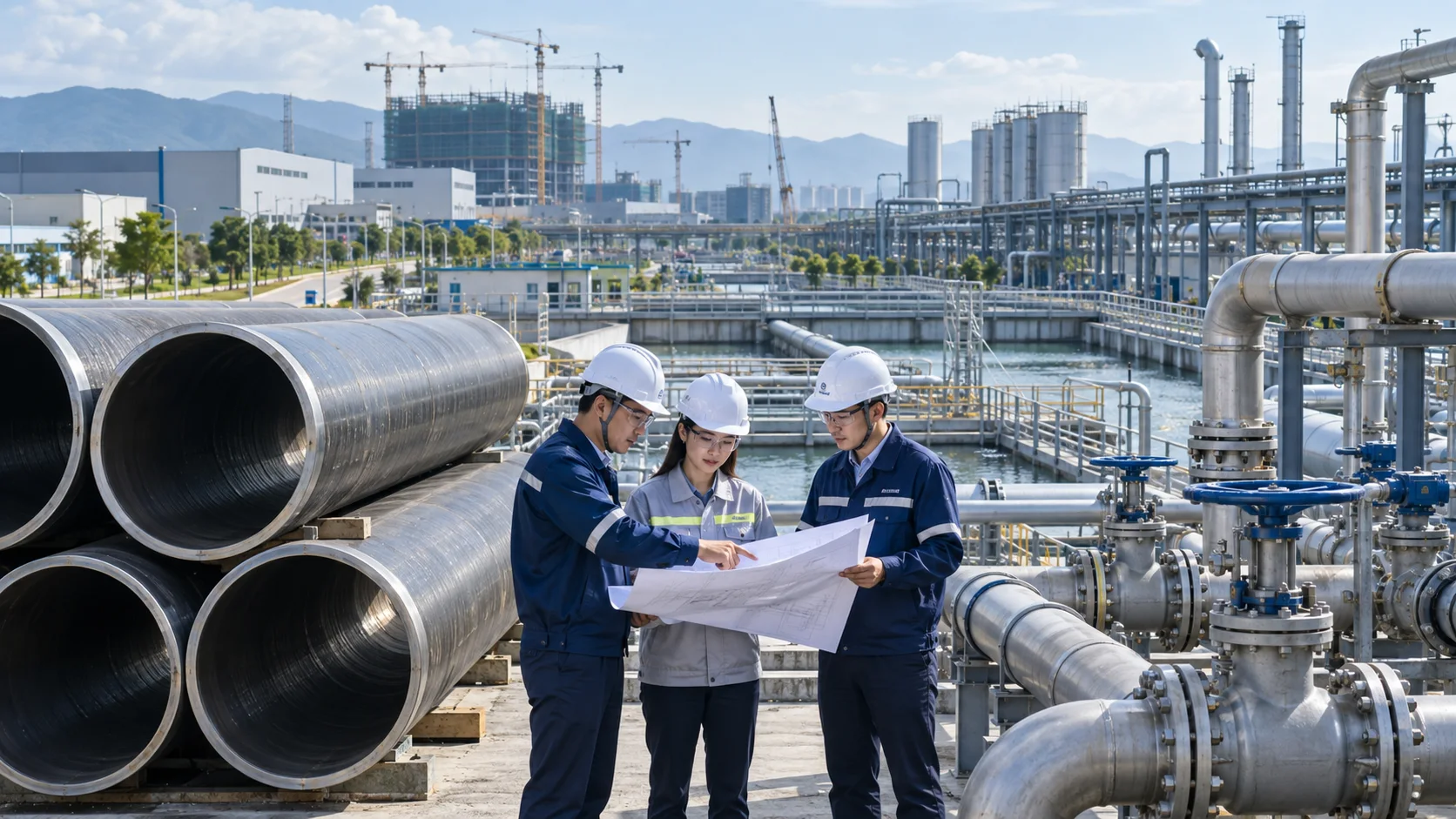
Vietnam’s urban growth and focus on reliable water services are creating continuing needs across water supply, drainage and wastewater systems. For suppliers, the opportunity is not a single product list: it is a project chain that runs from planning and design to construction, commissioning, operation and rehabilitation.
Water Infrastructure Covers Several Different Systems
Water-supply networks, wastewater collection, stormwater drainage, pumping stations and treatment plants have different operating conditions and procurement structures. A product suitable for a buried distribution main may not suit a corrosive treatment process, a pressure sewer or a pumping station.
Recent official information from Vietnam refers to continued work on safe water supply, leakage reduction, wastewater collection, transfer pumping and treatment facilities. These programmes and projects indicate areas of infrastructure activity; they do not guarantee orders for any supplier.
Where Suppliers May Contribute
- Transmission and distribution: pressure pipe, fittings, joints, isolation and control valves, air valves and surge-management components.
- Wastewater and drainage: gravity and pressure pipelines, corrosion-resistant materials, access components, pumps and flow-control equipment.
- Treatment facilities: process piping, chemical-service lines, stainless components, valves, actuators, instrumentation and fabricated assemblies.
- Pumping stations: pumps, check and isolation valves, manifolds, couplings, vibration control and monitoring.
- Network performance: metering, leak detection, pressure management, rehabilitation and digital monitoring.
- Quality and delivery: coatings, joining equipment, inspection, testing, traceability, packaging and site support.
Product Selection Begins With Service Conditions
Material choice should follow the design basis: water or wastewater characteristics, pressure, temperature, soil and groundwater conditions, external loads, corrosion exposure, installation method, joining system, maintenance access and intended service life. Buyers should compare the full system—including fittings, valves, seals, coatings and installation controls—rather than evaluate pipe price alone.
Project opportunity is specification-led. A supplier needs to understand the design duty, applicable standards, approval process and whole-life requirements before proposing a product.
Understand the Procurement Chain
A public authority, utility, project management unit or industrial owner may sponsor the investment. Consultants develop designs and specifications; EPC or civil contractors purchase packages; specialist subcontractors install systems; and local distributors may import, stock and support products. The organization influencing the specification may differ from the company issuing the purchase order.
Suppliers should identify project stage, funding and procurement route, responsible design consultant, approved-vendor requirements, package boundaries and local support expectations. Public and donor-funded projects may have formal tender and eligibility procedures that must be followed.
Documentation and Local Support Matter
- Product and material standards, dimensions and pressure ratings
- Potable-water or service-specific approvals where applicable
- Material certificates, coatings and batch traceability
- Hydrostatic, performance and other specified test records
- Installation procedures, training and commissioning support
- Spare parts, warranty response and long-term availability
- Vietnamese-language documentation or other project-required formats
Suppliers should verify current Vietnamese technical regulations, standards, import requirements and project specifications with the responsible buyer and competent advisers. A certification from another market may support qualification but does not automatically replace local or project approval.
How to Qualify a Real Opportunity
- Confirm whether the project is at planning, design, tender, construction or operation stage.
- Identify the owner, consultant, contractor and purchasing entity.
- Obtain the actual technical specification and bill-of-quantity context.
- Check standards, approvals, testing, documentation and local-service requirements.
- Clarify budget, procurement method, tender dates and decision process.
- Assess whether a local distributor, installer or service partner is needed.
- Plan technical follow-up around a defined application—not a generic catalogue presentation.
Connect With the Project Supply Chain at TPSV2026
TPSV2026 brings together pipe, valve, fitting, pump, processing and service suppliers with industrial buyers, distributors, contractors and project stakeholders. Exhibitors can present application-specific water and wastewater solutions; visitors can compare materials, documentation, delivery support and local partnership capability.
Related insight: See how Vietnam’s infrastructure development creates demand for tube, pipe, valves and processing solutions.
Sources and Editorial Scope
Context was checked against Vietnam Ministry of Construction reporting on the national safe-water and non-revenue-water programmes, the West Lake wastewater collection project, and the World Bank’s recent Vietnam Dynamic Cities project documentation. References to supplier opportunities are editorial interpretation, not tender notices, forecasts or confirmed procurement.