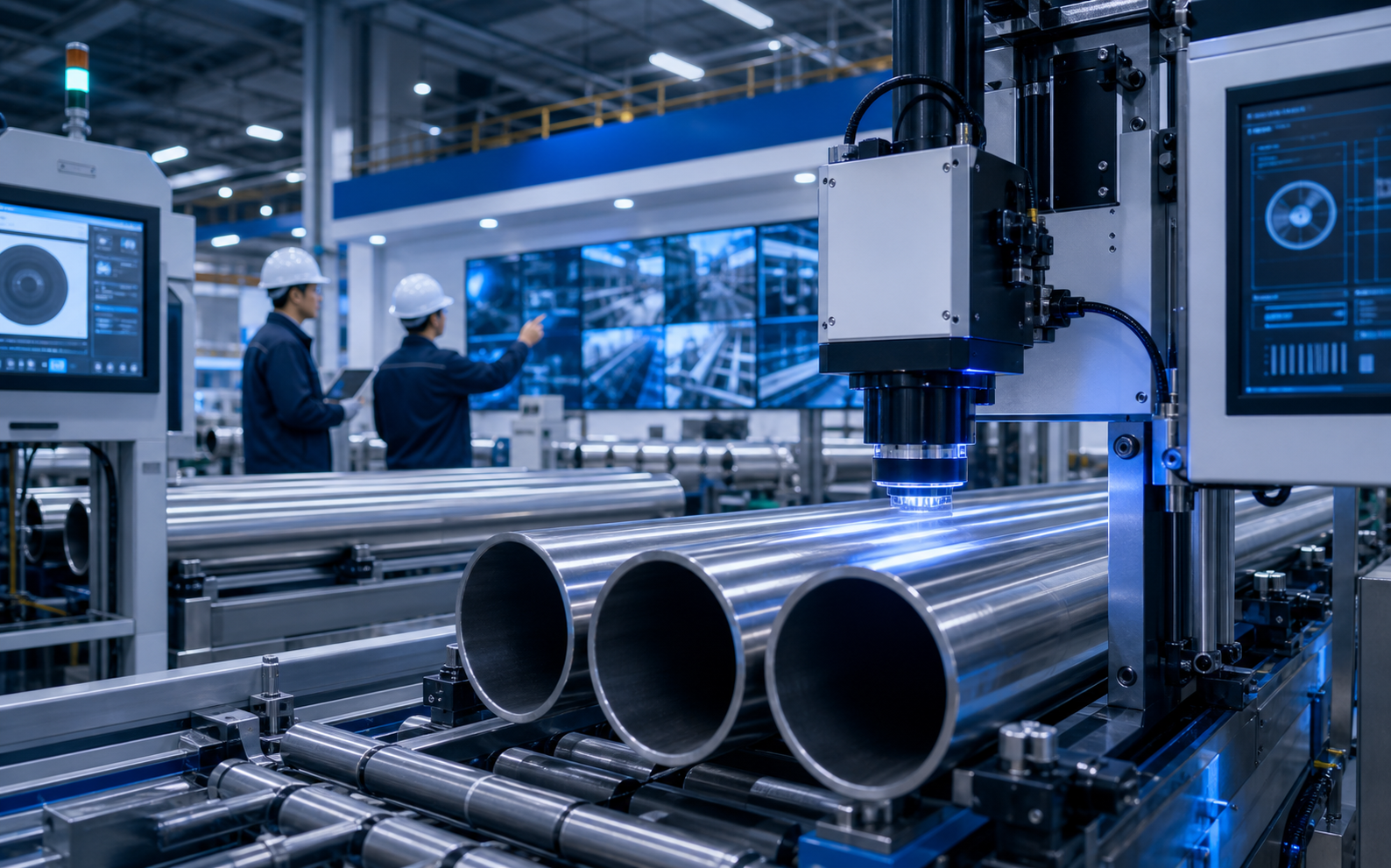
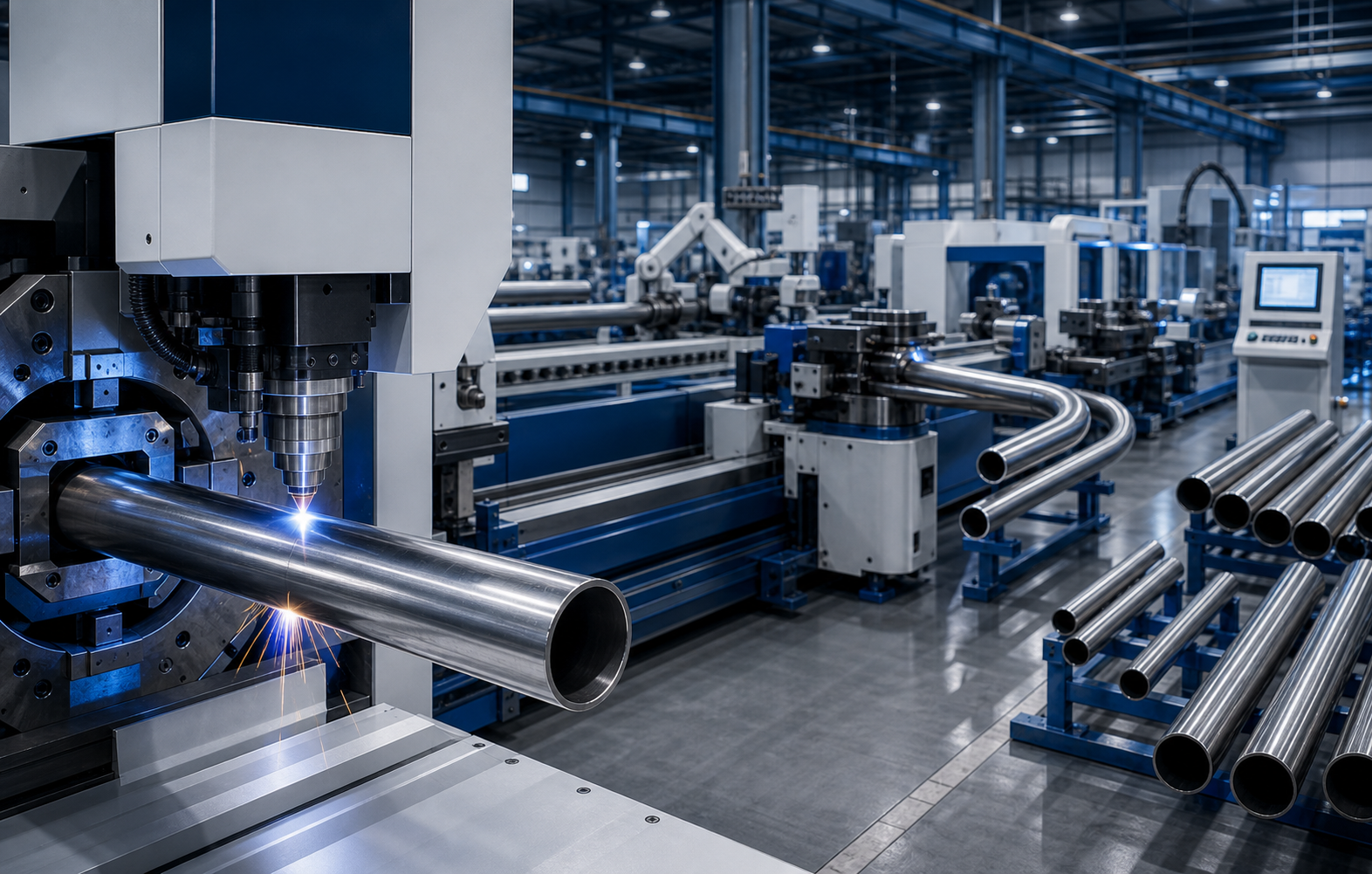
Smart manufacturing is not one machine or software package. It is the controlled connection of equipment, measurement, production data and people so that manufacturers can make better decisions about quality, performance and maintenance.
From Isolated Machines to Connected Production
Conventional automation can control individual production steps. Smart manufacturing extends this capability by connecting process measurements, machine status, quality results and production records. NIST describes smart manufacturing in terms of measurement science, in-process sensing, monitoring, model-based control and trustworthy systems and data.
For tube producers, the practical objective is not to collect the largest possible volume of data. It is to connect the measurements that matter—material identity, forming conditions, weld parameters, dimensions, surface condition, test results and machine health—to a specific production order or product.
The important distinction: automation performs a task; a connected manufacturing system also records what happened, relates it to product quality and helps qualified personnel decide what to do next.
Where Technology Is Changing Tube Production
- Process monitoring: Sensors can monitor operating conditions such as speed, temperature, force, vibration or electrical parameters where relevant to the process.
- Inline dimensional inspection: Non-contact systems can measure outside diameter, ovality or profile dimensions. Wall-thickness measurement requires a suitable method, such as properly specified ultrasonic equipment.
- Weld and surface inspection: Machine vision and appropriate nondestructive-testing methods can support the detection of defined discontinuities when correctly specified and validated.
- Identification and traceability: Production, inspection and material records can be linked to batches, coils, orders or individual products according to the required traceability level.
Inspection Technology Does Not Replace Engineering Control
An inspection system is only useful when its method, detection limits, calibration, reference standards, product range and response to an alarm are clearly defined. A visually impressive screen does not establish whether a system can detect the discontinuities or dimensional variations relevant to a particular standard or application.
Buyers should ask how the equipment is verified, how false indications are managed, what happens when a result is outside limits and how inspection records are retained. Where regulated or safety-critical products are involved, the applicable product standard, inspection procedure and qualified personnel remain essential.
The Role of Production Data
Connected data can help teams investigate defects, compare shifts, identify process drift and plan maintenance. NIST’s smart-manufacturing work also emphasizes interoperability and trustworthiness: information must move between equipment and software without losing meaning, and the data must be sufficiently reliable for its intended decision.
This is why a practical project usually begins with a limited problem and a measurable baseline. Examples include reducing unexplained dimensional variation, improving the completeness of inspection records or detecting a recurring equipment condition before it causes unplanned downtime.
Questions to Ask Before an Automation Upgrade
- Production scope: Which tube sizes, materials, speeds and product standards must the system support?
- Measurement objective: What characteristic must be measured, at what tolerance and under what line conditions?
- Integration: Which existing PLC, machine, quality and ERP systems need to exchange information?
- Validation: How will measurement accuracy, repeatability and detection performance be demonstrated?
- Data ownership: Where will records be stored, who can access them and how will they be backed up?
- Cybersecurity and continuity: How will connected systems be protected, maintained and operated if a network component fails?
- People: Which operators, engineers and maintenance teams need training?
A Staged Route to Smarter Production
Manufacturers do not need to replace an entire line at once. A lower-risk approach is to establish the current performance baseline, select one process or inspection problem, pilot the measurement and data connection, verify the results under real production conditions and then decide whether wider integration is justified.
Technology providers should explain not only equipment features but also installation conditions, calibration, training, integration responsibilities, service response and the evidence used to verify performance.
Compare Technologies at TPSV2026
TPSV2026 gives tube and pipe manufacturers an opportunity to compare production, welding, inspection, handling and automation solutions in one industry setting. Visitors can bring a defined application and discuss line speed, product range, tolerance, inspection method, data integration and service requirements directly with relevant suppliers.
Sources and Editorial Scope
Technical context was checked against the NIST Smart Manufacturing programme, the NIST Smart Manufacturing Systems Test Bed, the ISO/IEC smart manufacturing standards-map framework, and ISO 21763:2026 on smart manufacturing in the iron and steel industry. Technology examples are general editorial guidance; suitability and compliance must be verified for each product, line and applicable standard.
Continue the market review: Read the practical overview of tube and pipe demand across Vietnam’s manufacturing, construction and utilities sectors.
Register to Visit · Book a Booth · Browse Exhibitors · Request Meeting Support